Friday, January 25, 2013

The Proper Authority


While looking at Acts 19 and 20 we discuss the importance of having the proper authority. Paul was one of the men that had that authority and in these two chapters performed 5 different ordinances;

5 priesthood ordinances:
1. Baptism
2. Laying on of Hands
3. Priesthood Blessings
4. Blessed the sacrament
5. Raised a man from the dead.


1.Because the saints in Corinthian were not baptized by the proper authority Paul re-baptized the saints and gave them the Holy Ghost. 


2. This shows nonmembers that a special authority is needed in order to receive the blessings and fulfill the covenants you make with Heavenly Father.


3. When Paul gave them the Holy Ghost he laid his hands on their heads. It tells us in the forth Article of Faith that we believe one of the principles and ordinances is "Laying on of hands for the gift of the Holy Ghost."


4. During this time they had the Sabbath on the first day of the week, Monday. It was changed because of the “tumult” against Paul. They were being persecuted and couldn’t have the Sabbath on Sunday.

We are blessed to live in a time with the fullness of the gospel. We can fulfill all the ordinances needed to return to our Father in Heaven. What a blessing!

Friday, January 18, 2013

Paul's First Journey


Topic Choices (Choose One)

Choice 1: Acts 13–14. Paul’s First Mission

1.   Using the map “Paul’s 1st Journey” found in the map section of the institute student manual (p. 218), list the name of the place Paul started this mission and four other cities he taught in.
Paul started his mission in Antioch and from there went to
Salimas, Paphos, Iconium and Lystra.

2.   Review Acts 13:1–5 and outline in writing three points that could help a missionary who is discouraged.
Fasting, prayer, and listening to the Holy Ghost will allow missionaries the ability to have their hearts and mind open to the Lord. They can be directed to those who are ready to learn of the gospel.

3.   Read the Bible Dictionary entry for “Barnabas” and the institute student manual commentary for Acts 9:27, “Who Was Barnabas?” (p. 259). Write a paragraph describing Barnabas. What blessings and advantages do you see for the Lord sending missionaries out two by two?
Barnabas was a loyal member of the church and faithfully serving God during this time.  He wasn’t one of the twelve but was considered an apostle. He sold his home and his possessions to fulfill the law given to them to all be equal and continued to support himself, not relying on the Church for assistance.  He was “a good man, and full of the Holy Ghost and faith.”

4.   Review Acts 14:8–18. Explain in writing what happened to Paul and Barnabas. How did Paul and Barnabas respond to this praise and attention?
Paul and Barnabas in Lystra
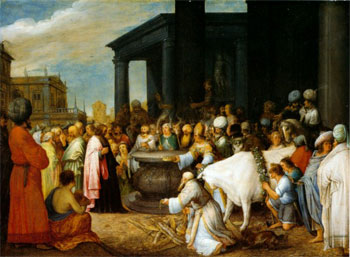
Paul and Barnabas were in Lystra and saw a man who was lame since birth. They healed him based on his faith and the people praised them. The people said they were gods and called them Jupiter and Mercurius. The people wanted to make sacrifices to them but Paul and Barnabas stopped them and gave all of the credit to the Lord. They used it as a teaching opportunity.

5.   Review Acts 14:19–22 and compare in writing the way the people treated Paul in these verses with how he and Barnabas were treated in Acts 14:8–13. How did Paul say we would enter the kingdom of God? How are both these experiences examples of the principle Paul taught in verse 22?
In verses 8-13 they were praised and respected whereas in verses 19-22 Paul was stoned and dragged out of the city. They wanted him dead! He wasn’t dead and went on teaching the word of the Lord. He went to other cities then came back to the one he was stoned in and told the disciples that they would enter the kingdom of God after “much tribulation.” In both examples they exercise faith in the Lord. When we have faith in God we can make It through our trails and return to live with him.

Friday, January 11, 2013

Choice 6 Herod and Peter!

And I'm back! This is the second half of the New Testament, Acts through Revelations and I'm pretty excited. For this share and report I will be looking at Acts chapter 12. I'm going to compare and contrast King Herod and the Prophet Peter.


Choice 6: Acts 12. Herod and Peter


Read Acts 12. Compare and contrast the two main characters. Complete the following chart:


Herod, the King
 
Peter, the Prophet
 
What motivated each of them?
 
Herod was motivated by hatred and by his people. "He saw that it (being the death of James) pleased the Jews." So with this he decided to do the same to Peter.
 
Peter was motivated by the Lord. The Lord had given him a work to do and he wanted to fulfill his duty to the people. Members of the church prayed for him and the Lord harkened unto their prayers!
 
How did they deal with others?
 
Herod was vicious to others. He was killing the prophets in cold blood. He sentenced Peter's guards to death because they let him escape.
 
The Prophet Peter was mindful of others. When he escaped he went right to Mary's (the mother of John) house to tell them that he was freed and safe from harm.
 
How did God deal with them?
 
Herod was a wicked man and was mocking God. The Lord then caused him to be eaten by worms. He was given a disease and died!
 Peter was blessed and was sent an angel from the Lord to release him from prison.